Wednesday, 23 October 2013

Skinner's Room

Its been awhile since I mentioned reading for pleasure, so I'm going to throw down a brief review of a brief story by one of cyberpunk's brain-daddy's, William Gibson. Forgive me in advance if I become pedantic.

First off, let it be known that I love cyberpunk as a genre. I love what imagined future societies can reveal about what we turn a blind eye on in our own society. I love the predictive nature of cyberpunk fiction--how it seems, like science fiction in general, not only to be able to predict technological trends, but also social, political, and economic trends.

Indeed, societal factors feature prominently in much of cyberpunk fiction, allowing for an entire genre--more than any other genre since the satire (Irish babies, anyone?)-- that provides starkly revealing (but at the same time entertaining) looks at the world we are building for ourselves.

"Skinner's Room" (1991) follows this model.   It tells of a massive, physics-defying slum built skywards on San Francisco's Bay Bridge. Getting into the story, I was reminded once again of how absolutely drool-worthy Gibson's prose is. My imagination was captured by descriptions of the bridge's "riot of secondary construction", its "makeshift ligatures of taut and rusting wires", "borrowed neon" , "surfaces of plywood, marble, corrugated plastic, polished brass, sequins, Styrofoam, tropical hardwoods, mirror, etched Victorian glass, chrome gone dull in the sea air." Somehow, the descriptions brought up memories of Studio Ghibli films, which often feature maze-like, hacked together, impoverished settings that still maintain the sense of freedom and mystique that Gibson's bridge slum has in this story. (I can't speak for the other Bridge stories. Apparently the notion of this slum later became a trilogy)
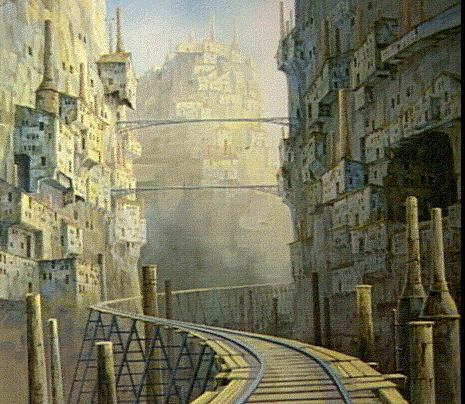

So, being set in a slum, the social commentary element is obviously there, though not exactly spoken to directly. What is spoken to directly his the slum's history. This is partly due to the age of the title character, who appears to be quite old, and who has, to the best of anyone's memory (though memory in this story is not very good, reality getting mixed up in dreams) grown up with the slum from its inception. The girl who looks after Skinner (known only as "the girl") is as mysterious as Skinner himself. While his past is nearly forgotten, her past is barely mentioned (perhaps something she *wants* to forget), and yet she seems to have a thirst to know more about the city and society as it was before traffic bridges were shut down and taken forcefully for makeshift housing in an obviously overpopulated and polluted world.


Indeed, the story hardly tells us anything definite at all about any of its characters. In typical Gibson/cyberpunk style, the story is more in what is *not* being said, than what is. He gives us a few facts, some deliciously described memories, peppered with absolutely inconsequential dialogue, and manages to paint an entire world that the reader thirsts to know more about. The reader is almost forced to write a secondary story to parallel and fill in the blanks of Gibson's narrative, and this literary tantalization of the imagination is part of what makes Gibson one of science fiction's greats.

Sunday, 20 October 2013

Dark Tower

Why do so many fantasy/scifi/horror stories feature dark towers? I don't know. Here's one to feed your imaginnations, though.

Thursday, 17 October 2013

At Work: Historical Images of Labour in Saskatchewan

Is it self-serving if I do a review of one of the sites my archive has developed? How about if it is from before I worked there?

The University of Saskatchewan Archives and Special Collections has long held it a mandate to make available online interesting or valuable elements of their collection. They take digitization of archival materials, and the production of topic-focused websites very seriously. The idea is to digitally synthesize holdings so that they can be viewed from new or different perspectives. The value of this practice as an outreach tool is obvious, and while sites such as this may be of less use to the experienced researcher, they are a good way of making archival materials available, accessible, and easily understandable to the public at large.

One example I stumbled across today:

At Work: Historical Images of Labour in Saskatchewan


So, lets talk about this little gem. It was created in 2010, and so (yeah yeah, just three years old) is slightly outdated. Splash pages are outdated, but I like the image they chose here. The project was conducted in combination with the efforts of a number of other local archives. The introductory page is well written, explaining the purpose of the digital collection as showing that we do, in fact, do more in Saskatchewan than agriculture. The scope of the project covered those labourers paid a wage for their work, which was of a manual or non-professional nature. Determining the scope of a project like this is often the hardest part, I'll add. Its easy to say "I want to digitize every picture of a woman in a dress within this archive" but its much less easy to actually DO it.

The first point of access to the actual galleries is through the "Themes", which are an array of subject headings, each with its own explanation, and a link to the gallery in full. Personally, I am not a huge fan of this approach, as it reads too much like a book and too little like a website -- not to mention being an affront to the three click rule for those wanting to get at the meat of the site: the gallery. Nevertheless, the topics listed and information attached make for interesting browsing, and therefore may be of use to the casual explorer rather than the determined researcher.

The second point of access is through the "Search all images" function. The only thing I would change here would be to make the search more dominant and friendly to those young "scholars" growing up in the "Google age".  Obviously, the search feature is nowhere near as advanced as Google, but is quite functional and easy to use (and useful) for what it is. Its easy to forget that developing an uber-search-algorithm is something libraries and archives just don't have the resources for, and this can be a source of frustration for researchers who are used to the cleverly ranked and sorted results they get through a Google search engine.

Another point of access targeted at casual browsers is the random image feature, which pulls up fifteen or so random images from the collection for the user to look at. I LOVE this feature. I think its playful and clever and fun, and a good way to figure out what in the collection might interest you without limiting yourself to a theme right off the bat.

There is a separate page for video clips, which is always impressive: film is neither easy nor cheap to digitize. The only issue here is that the videos aren't searchable through the search page. Of course, this is maybe not an issue at all, because there aren't that many videos to begin with, and so are easy to browse.

The site then goes on to provide educational resources, including book suggestions in excerpts related to labour in Saskatchewan, a brief historical survey of labour in Saskatchewan (listed as a resource for teachers, but really a solid background resource for pretty much anyone), and most importantly, an extensive bibliography to spur further study. Copyright and contact information for all of the participating archives is also provided, as well as a list of acknowledgements, and the (little-used, but still helpful) site map.

All in all, this is a compact, well targeted site. Visually, I think it has its own charm although it isn't the prettiest archival site out there. I especially like the moving sidebar which prevents over-scrolling. The gallery is easy to use, and the metadata on the photos is magnificent.

K, I'll quit patting my office on the back now. . .

Wednesday, 25 September 2013

Controlled Climate

Let me introduce you to my archenemy:

Mr. Breezy

Dun dun daaah: the ventilation system. When I first started work at the archives, this dude was constantly blasting cold air at our backs.

After weeks and weeks of suffering through this, we finally got up the gumption to play with our thermostat (not always the best idea in an archive/special collections office, but we were desperate, and tired of wearing jackets in July):

The room began to warm up! and for a time, things were good :). But . . .the warming trend did not stop. The working room got hotter . . .and hotter . . .
AND HOTTER
. . . until sweaty-handed me couldn't do my work properly without sweating all over archival documents and rare books. No bueno. So they got me this!


And once again, for a brief time, everything was good. That is, until the maintenance guy arrived. Well meaning, he told us the thermostat was broken, and that was the cause of our overheating distress. The fix? 
no thermostat
Proudly, the maintenance fellow announced that our heat problems were solved. . .we were now on full cool! Which, of course meant that my friend
Mr. Breezy
was back. 
 
The joys of library living! I have yet to set foot in one whose temperature is just right. Until then,

Chillily yours

Monday, 23 September 2013

Idiolect

Some things I am saying way too much lately. I apologize to everyone who has to deal with me:

1.) . . .for REASONS
example: I ate a ham sandwich . . .for REASONS
translation: There was no reason to eat the ham sandwich. I wasn't even hungry. I don't like ham.

2.) ALL DAY
example: I've been eating this ham sandwich ALL DAY.
translation: I've been eating this ham sandwich for the past five minutes.

3.) It ok tho
example: This ham sandwich tastes like ass. . . it ok tho
translation: This ham sandwich tastes like ass, but I'll survive

4.) I fail
example: I couldn't finish the ham sandwich. I fail.
translation: I couldn't finish the ham sandwich. This is more or less inconsequential

5.) RRRWWWWWAAARRRGGHH
example: RRRWWWWWAAARRRGGHH
translation: a heartfelt expression of one's inner frustrations and turmoil

Friday, 20 September 2013

Nursery Rhyme

I am a doll at tearoom table
Smile, nod, as I am able
Your words choke at me rich and sable
until I can not breathe.
Force fed another fable,
my limbs too stiff to leave.

Words cling to parchment tongue
cleave to throat, freeze in lung
The organ seeks a lunellum
to scrape the vellum clean.
In blank-space new words will come
and I'll say what I mean.

I mean to say--
I mean to do--
my teacup's empty,
so are you.
We sit frozen in tableau
for yet another day;
it is the playroom way.