Long time no blog, dawg. Not gonna make excuses, except that Christmas happened, and appraisal season is coming up, and I've been battling off the winter blues, and and and. . .
Ahem
So, today's rumination of choice is on the pro-life versus pro-choice debate. Typically, I have avoided getting into discussions about this topic, as everyone and their dog seems to have very strong opinions, and will fight tooth and claw for one side or the other.
The truth is, I don't really have a strong opinion. If it came down to it, I would fall on the "pro-choice" side of the spectrum, as I believe ultimately what a woman does with her body should be her own to decide. But I don't feel the need to back that belief up with philosophy, constitutional babble, feminist rage, or the typical series of "what if's " (what if she was raped? what if giving birth would kill the mother? what if she cannot afford to raise the child?).
It is not that there is no validity in these arguments -- there is. However, from my perspective, these discussions tend to take away from the reality of the choice in pro-choice.
By turning the topic into a matter of philosophy or politics, putting it in the drawing room or on the political platform, the emotional impact of the choice is drained away, and you might as well be discussing taxation or smoking pipes and rambling abstractly about ethics.
"Pro-choice" is often used in feminist hands as a sort of weapon, another blade from the armory. Again this distracts from the reality of the choice -- "pro-choice" becomes more of a tagline or a battlecry, than something centered on a real decision to be made.
As to the "what ifs", I find them irrelevant. Certainly, they play a role in how the choice might come to be made, but they make weak pillars when upholding the right to make that choice, because they take something that is very real, and throw it into the realm of the hypothetical.
What I'm trying to get at here is that it is easy to lose track of the choice in pro-choice when everyone gets caught up in picking sides and debating themselves blue in the face.
Yes, I believe every woman should have the right to choose. I am happy to live in a country where abortion is legally an option for me. But if it came right down to it, and I found myself with an unwanted pregnancy, would I choose abortion?
I honestly don't know.
If I were thinking just in terms of philosophy, politics, or what I believe about women's rights, I'd go for it in an instant. But when faced with such a choice, none of that really matters, does it?
And, for that matter, the choice of whether to bring a life into the world, or hold it back, is one that exists independently of the law. Abortions were performed before safe medical procedures were ever invented, and abortions would continue even without governmental approval and proper medical support.
Strip away the philosophy and the politics, the question of a woman's rights and the "what ifs", and you are left with a choice, the same choice women have been making for centuries.
And it is, and always will be the most difficult--and most important--decision a woman can make.

Showing posts with label Rambles. Show all posts
Showing posts with label Rambles. Show all posts
Tuesday, 20 January 2015


Wednesday, 15 October 2014
Thanks Giving
So, Canadian Thanksgiving was this past weekend and although we didn't celebrate in the traditional sense, I thought I'd harness the spirit of the season and throw down a few things from the past year that I have been thankful for (in no particular order):
* First of all I am thankful that my Dad wasn't horribly crushed in his tractor accident a few weeks back.
* I am thankful for having a family that I am close to, and getting closer to. Even if we don't always agree and sometimes have fighting and sadness and hurt feelings--in the end its all worth it.
* I am thankful for the friendships I am building/rebuilding. I am grateful for all of the people who let me be a part of their lives and put up with my weirdness.
*I am thankful for Stewart--for his patience, gentleness, warmth, intelligence, and humor.
*I am thankful that I have a truly great set of co-workers that make going to work a pleasure. Likewise, I am thankful for my job which has enough variety and fast-paced interesting action to keep me busy and absorbed for hours and hours.
*I am thankful that I seem to have matured from the person I was even this time last year. I am more honest with myself and others, and this has had the added benefit of making me feel less shitty about myself.
*I am thankful for nachos and salsa, which I have recently rediscovered.
*I am thankful for nerdy television, which will get me through the coming winter.
*I am thankful, always, for hot baths. Preferably hot baths with candles, incense, bath salts, and a beverage.
*I am thankful that I have rediscovered the joys of reading for pleasure in the past year.
*I am thankful for my health plan.
*I am thankful for my little RAV, and my drivers license, which let me get from place to place to place at a whim. They don't call me "road warrior" for nothing.
* I am thankful for the unseasonably warm October we've been having.
For awhile there I was keeping a gratitude journal--writing down five things every day that I was grateful for. You'd think this would be hard, but really it's not. The world is full of amazing things--small miracles and big ones--that can be seen only when you're in the frame of mind to look. I'd like to get back in the habit of a gratitude journal. Its a good way to remind oneself that no matter how you square it, things are never as bad as you might first think. There is always *something* to be thankful for,
* First of all I am thankful that my Dad wasn't horribly crushed in his tractor accident a few weeks back.
 |
| What's left of the tractor |
* I am thankful for having a family that I am close to, and getting closer to. Even if we don't always agree and sometimes have fighting and sadness and hurt feelings--in the end its all worth it.
* I am thankful for the friendships I am building/rebuilding. I am grateful for all of the people who let me be a part of their lives and put up with my weirdness.
*I am thankful for Stewart--for his patience, gentleness, warmth, intelligence, and humor.
*I am thankful that I have a truly great set of co-workers that make going to work a pleasure. Likewise, I am thankful for my job which has enough variety and fast-paced interesting action to keep me busy and absorbed for hours and hours.
*I am thankful that I seem to have matured from the person I was even this time last year. I am more honest with myself and others, and this has had the added benefit of making me feel less shitty about myself.
*I am thankful for nachos and salsa, which I have recently rediscovered.
*I am thankful for nerdy television, which will get me through the coming winter.
*I am thankful, always, for hot baths. Preferably hot baths with candles, incense, bath salts, and a beverage.
*I am thankful that I have rediscovered the joys of reading for pleasure in the past year.
*I am thankful for my health plan.
*I am thankful for my little RAV, and my drivers license, which let me get from place to place to place at a whim. They don't call me "road warrior" for nothing.
* I am thankful for the unseasonably warm October we've been having.
For awhile there I was keeping a gratitude journal--writing down five things every day that I was grateful for. You'd think this would be hard, but really it's not. The world is full of amazing things--small miracles and big ones--that can be seen only when you're in the frame of mind to look. I'd like to get back in the habit of a gratitude journal. Its a good way to remind oneself that no matter how you square it, things are never as bad as you might first think. There is always *something* to be thankful for,
Thursday, 9 October 2014
Master of Extremes
Because talking about myself never gets old--AHAHAHAHAHAHA

ahem. . .
Trying to get out a thought that's been bobbling about in my head all day regarding two equal and opposing beliefs about myself that I hold with absolute conviction.
The first will surprise those of you that spend any amount of time with me. I believe, with every fiber of my being, that I am a great person--maybe even an amazing person, with massive amounts of potential, mad skillz. a good head on her shoulders, more personality than your average bear, a unique way of looking at the world, and a good deal of inherent strength.
At the same time, I believe, just as strongly, that I aim a huge failed waste of flesh, and should probably be trampled to death by a rogue mammoth. This will be more familiar to those around me, as I tend to talk myself down more than up (something I think I do because I fear talking myself up would make me unbearable to be near--and I'm already unbearable enough (there she goes again)).
Having these two contrary self images--that I am invaluable, and that I am un-valuable; that I am both awesome and insignificant--sometimes feels like the emotional equivalent of being strung up spread-eagled on barbed wire, being pulled in two different directions.
You might laugh, say "Stevie, Stevie. Don't you know you are not either of these things? You are just a human, like anyone. You have successes, you make mistakes" , and I would have to agree. Let me rephrase : CONSCIOUSLY , LOGICALLY , and RATIONALLY I would be inclined to agree. Unfortunately I am rarely rational, infrequently logical, and usually just barely conscious. I am unable to disabuse myself of either the notion that I am somehow super, or the notion that I am superfluous. I have been trying, for a long time.
So, I suppose my question for you, dear reader, is this : do you ever feel this same way? Torn between two extremes, neither of which reflects the reality in which you exist?
ahem. . .
Trying to get out a thought that's been bobbling about in my head all day regarding two equal and opposing beliefs about myself that I hold with absolute conviction.
The first will surprise those of you that spend any amount of time with me. I believe, with every fiber of my being, that I am a great person--maybe even an amazing person, with massive amounts of potential, mad skillz. a good head on her shoulders, more personality than your average bear, a unique way of looking at the world, and a good deal of inherent strength.
At the same time, I believe, just as strongly, that I aim a huge failed waste of flesh, and should probably be trampled to death by a rogue mammoth. This will be more familiar to those around me, as I tend to talk myself down more than up (something I think I do because I fear talking myself up would make me unbearable to be near--and I'm already unbearable enough (there she goes again)).
Having these two contrary self images--that I am invaluable, and that I am un-valuable; that I am both awesome and insignificant--sometimes feels like the emotional equivalent of being strung up spread-eagled on barbed wire, being pulled in two different directions.
You might laugh, say "Stevie, Stevie. Don't you know you are not either of these things? You are just a human, like anyone. You have successes, you make mistakes" , and I would have to agree. Let me rephrase : CONSCIOUSLY , LOGICALLY , and RATIONALLY I would be inclined to agree. Unfortunately I am rarely rational, infrequently logical, and usually just barely conscious. I am unable to disabuse myself of either the notion that I am somehow super, or the notion that I am superfluous. I have been trying, for a long time.
So, I suppose my question for you, dear reader, is this : do you ever feel this same way? Torn between two extremes, neither of which reflects the reality in which you exist?
Thursday, 31 July 2014
On Beauty
I shall be as drab as a peahen.
My hair shall be as tangled ivy,
My teeth stained to ivory.
My legs and darkened places will bear the prickles of a cactus--both warning and challenge.
My flesh shall roll as the hills and meadows; bear those same scars.
My wardrobe a coat of many colours, clashing and threadbare.
And I will be beautiful, for I will be myself.

My hair shall be as tangled ivy,
My teeth stained to ivory.
My legs and darkened places will bear the prickles of a cactus--both warning and challenge.
My flesh shall roll as the hills and meadows; bear those same scars.
My wardrobe a coat of many colours, clashing and threadbare.
And I will be beautiful, for I will be myself.
Wednesday, 5 March 2014
Dingoes Ate My Baby!
Poor neglected blog. Here is a random morbid post to cheer you up.
"A Dingo Ate My Baby!"
We've all heard this quoted. I never knew the origins of the quote until today, however. It is a phrase attributed both to the mother of a real Australian baby who was (controversially) taken and killed by dingo's in this famous case (it was 1980, 7 years before I was born. Can you fault me for not knowing?), and to Meryl Streep who acted the role of that mother in 1988's Cry in the Dark. References have also been made in Seinfeld, Frasier, Buffy, and Supernatural
The more you know.
Now here are pictures of Dingo's doing more civilized things:


"A Dingo Ate My Baby!"
We've all heard this quoted. I never knew the origins of the quote until today, however. It is a phrase attributed both to the mother of a real Australian baby who was (controversially) taken and killed by dingo's in this famous case (it was 1980, 7 years before I was born. Can you fault me for not knowing?), and to Meryl Streep who acted the role of that mother in 1988's Cry in the Dark. References have also been made in Seinfeld, Frasier, Buffy, and Supernatural
The more you know.
Now here are pictures of Dingo's doing more civilized things:
Also on the subject of dogs and civilization:
Wednesday, 4 December 2013
The Art of Acting Hostess
It seems to me, that hosting any gathering (no, we're not talking hostess in the airline or twinkie sense) has become a more complex affair in recent years. As fad diets, new eating preferences, and new food allergies emerge, today's hostess is challenged to be more aware of the needs and wants of her guests than ever before. If she wants to be successful, that is.
[An aside: Yes, this is a gendered post . . .no, I'm not saying that men can't host gatherings. I was inspired to write this post by this little book from the early 1900's offering up some guidelines for proper hostessing, and the book itself was, interestingly, written by a man named Paul Pierce : http://www.gutenberg.org/catalog/world/readfile?fk_files=1859388]
While the hostess of yesterday was concerned with producing an endless flow of dishes that would "occupy in part the attention of the guests and tend to promote the success of her favorite dish by allowing her to proceed in its preparation undisturbed by haste or excitement," today's hostess has to worry about what sort of bloating, rash, physical discomfort, or ultimately gruesome death she may potentially be inflicting upon her guests.
Mr. Pierce ridicules those who are anxious in the kitchen, jesting "why there should be so much excitement over the cooking of an ordinary rarebit, a creamed chicken, a souffle of oysters or all this terrible excitement about a lobster Newberg or a simple cheese fondue is beyond comprehension." Arguably, today's hostess experiences the same sort of anxiety in deciding upon something as simple as which cookie to bake -- should it be gluten free, low in fat, vegan safe, sans nuts, and diabetic friendly?
 I know, I know, we give credit to the woman of the past for her ability to pull off elegant and complex dishes in multiple courses over the duration of a long night without a dollop of gravy on her frock. But really, what the modern woman does, or attempts to do when she entertains is just as impressive. Not only are we attempting to bring together in a social manner a group of people who have become unused to social interaction unmediated by a touch screen, but we are attempting to do it on our one day off of a week of working. Shopping for quality ingredients, prepwork, actual cooking, and of course the weekend ritual of cleaning house (something the old "American aristocrat" of Pierce's time didn't have to do) can eat up an entire day before anything resembling actual eating even begins. Any woman who does all this, even if her dinner isn't as complex and has a few less courses than those described by Pierce, should be proud of her work. And it IS work, as anyone who as ever tried to cook more than three things at once can attest to.
It is comforting to know, however, that we do share some of the same aspirations and concerns as our century-separated counterpart. Themed dinners were as popular a hundred years a go as they are now (and presumably just as fun to put on). Pierce poignantly explains the difficulties of a young woman wanting to entertain in a small space (a section of his book I might need to go back and look over more thoroughly -_-u) saying: "there are some people to whose distorted vision the tiniest molehills are magnified into veritable chains of mountains, rugged and insurmountable; and if, in addition to their other woes, they happen to be unfortunate enough to dwell in a flat, their desolation is complete." The same is very much true today. There is something isolating about living in a small space by oneself--a problem which grows as more and more people resolve to spend their lives alone in the modern day.
I could go on and on comparing this witty little book to our present day entertainments, but I suppose instead I will leave you with these compelling words from Pierce: some women " have a perfectly inexplicable talent for making life livable" and " bring[ing] forth into the bright sunshine the many opportunities which everyone's life contains." I think that this is something we should all strive for--be it by having friends over for an evening of good food and company, fixing our boyfriend's car, or just smiling at a random stranger.
[An aside: Yes, this is a gendered post . . .no, I'm not saying that men can't host gatherings. I was inspired to write this post by this little book from the early 1900's offering up some guidelines for proper hostessing, and the book itself was, interestingly, written by a man named Paul Pierce : http://www.gutenberg.org/catalog/world/readfile?fk_files=1859388]
While the hostess of yesterday was concerned with producing an endless flow of dishes that would "occupy in part the attention of the guests and tend to promote the success of her favorite dish by allowing her to proceed in its preparation undisturbed by haste or excitement," today's hostess has to worry about what sort of bloating, rash, physical discomfort, or ultimately gruesome death she may potentially be inflicting upon her guests.
Mr. Pierce ridicules those who are anxious in the kitchen, jesting "why there should be so much excitement over the cooking of an ordinary rarebit, a creamed chicken, a souffle of oysters or all this terrible excitement about a lobster Newberg or a simple cheese fondue is beyond comprehension." Arguably, today's hostess experiences the same sort of anxiety in deciding upon something as simple as which cookie to bake -- should it be gluten free, low in fat, vegan safe, sans nuts, and diabetic friendly?
 I know, I know, we give credit to the woman of the past for her ability to pull off elegant and complex dishes in multiple courses over the duration of a long night without a dollop of gravy on her frock. But really, what the modern woman does, or attempts to do when she entertains is just as impressive. Not only are we attempting to bring together in a social manner a group of people who have become unused to social interaction unmediated by a touch screen, but we are attempting to do it on our one day off of a week of working. Shopping for quality ingredients, prepwork, actual cooking, and of course the weekend ritual of cleaning house (something the old "American aristocrat" of Pierce's time didn't have to do) can eat up an entire day before anything resembling actual eating even begins. Any woman who does all this, even if her dinner isn't as complex and has a few less courses than those described by Pierce, should be proud of her work. And it IS work, as anyone who as ever tried to cook more than three things at once can attest to.
It is comforting to know, however, that we do share some of the same aspirations and concerns as our century-separated counterpart. Themed dinners were as popular a hundred years a go as they are now (and presumably just as fun to put on). Pierce poignantly explains the difficulties of a young woman wanting to entertain in a small space (a section of his book I might need to go back and look over more thoroughly -_-u) saying: "there are some people to whose distorted vision the tiniest molehills are magnified into veritable chains of mountains, rugged and insurmountable; and if, in addition to their other woes, they happen to be unfortunate enough to dwell in a flat, their desolation is complete." The same is very much true today. There is something isolating about living in a small space by oneself--a problem which grows as more and more people resolve to spend their lives alone in the modern day.
I could go on and on comparing this witty little book to our present day entertainments, but I suppose instead I will leave you with these compelling words from Pierce: some women " have a perfectly inexplicable talent for making life livable" and " bring[ing] forth into the bright sunshine the many opportunities which everyone's life contains." I think that this is something we should all strive for--be it by having friends over for an evening of good food and company, fixing our boyfriend's car, or just smiling at a random stranger.
Tuesday, 26 November 2013
This is War
The battles begin once again, nature's forces descending upon us with bitter cold steel drawn naked, prepared to cut. We draw our weapons too, don goose-down armour and hack at frost with scrapers bought at Canadian Tire or makeshift from old Tim Horton's gift cards. We carry shovels like standards into battle, carve out a path through the endless forces of our enemy before they overwhelm entire.
Charging into the wind, pom-poms leveled lance-like at the elements , we press forward. Toques for helms mittens for gauntlets, and thick rubber soled shoes for purchase on home lands turned treacherous in the enemy's icy grip.
Politicians penguin-waddle in parkas and tell us we are prepared, this time. This war will not be like the last, they say. Our forces are organized. . .we will reclaim the frontiers of our streets and sidewalks with clattering monstrous beasts of our own invention that split the night with roars and beeps. I remember that you cannot trust politicians, as I slide sideways on snow-packed roadway, four wheel drive or no.
I am certain this years war, like last year's, will end. But at what cost? How many fenders bent, arms broken, and tears shed at the voidlike blackness of ten in the morning?
Vaguely, I remember a time when this was not a fight. Too young to understand the threat the enemy posed, I embraced it instead. My enemy was then my ally, providing me with ammunition against other, then more important enemies. My enemy and I clutched eachother and shrieked laughter as we slid down hillsides, danced across glistening floors of ice. My enemy could take a form very much like my own, but with a carrot nose, an old scarf, two rocks for eyes. My enemy was my friend.
Is there an opportunity for peace, after all?
Oh Hell no.
Charging into the wind, pom-poms leveled lance-like at the elements , we press forward. Toques for helms mittens for gauntlets, and thick rubber soled shoes for purchase on home lands turned treacherous in the enemy's icy grip.
Politicians penguin-waddle in parkas and tell us we are prepared, this time. This war will not be like the last, they say. Our forces are organized. . .we will reclaim the frontiers of our streets and sidewalks with clattering monstrous beasts of our own invention that split the night with roars and beeps. I remember that you cannot trust politicians, as I slide sideways on snow-packed roadway, four wheel drive or no.
I am certain this years war, like last year's, will end. But at what cost? How many fenders bent, arms broken, and tears shed at the voidlike blackness of ten in the morning?
Vaguely, I remember a time when this was not a fight. Too young to understand the threat the enemy posed, I embraced it instead. My enemy was then my ally, providing me with ammunition against other, then more important enemies. My enemy and I clutched eachother and shrieked laughter as we slid down hillsides, danced across glistening floors of ice. My enemy could take a form very much like my own, but with a carrot nose, an old scarf, two rocks for eyes. My enemy was my friend.
Is there an opportunity for peace, after all?
Oh Hell no.
Sunday, 10 November 2013
Carport Olympics
Carports: Things we don't have a lot of in Canada save for in front of hotels. Or to shelter that boat you wish you'd never bought that won't fit in the garage. Probably the biggest reason carports aren't popular up here is the obvious one: its cold and despite all our bluster, we're wusses. Going out into an unheated garage to start up the car in the morning is bad enough, and at least when you park your car on the street you're fairly certain you can get the car off and driving thanks to midnight snowplows (barring a blizzard, in which case you're probably allowed to stay home anyway). Carports have the dual disadvantage to us northern dwellers of lacking walls to block the icy cold winds, and being vulnerable to snow that will not be happily removed for you by any civic snowplow--or any hand but your own mittened one frozen to the shovel.
So, we don't really use car ports. But then, does anyone excessively? Unsure. Haven't traveled enough. Moving on.
Regardless of the lack of applicability of the carport to my own culture, I thought I'd throw up a few pictures of some interesting examples of these under-appreciated architectural sidebars. So here goes, in no particular order:
1. The Overhang - Villa Midgard, Stockholm

Because nothing screams "its safe to park your car here" like a concrete overhang. Concrete is indestructible, right?
2. The Solar powered bike rack

This solar powered beauty can at once charge your electric car and store your bikes while taking up minimal space. I call this a pretty cool little wonder of technology. It looks fairly easy to set up too, considering what it is.
3. The Green Rooftop-port

C'mon, for a warm climated place, you gotta admit this is a pretty cool idea. My only question is how/if you can get on top of it.
4. The Hollywood Hills

Something sort of Jetson-y about this lean-to design, circa 1972.
5. The F**k You Gravity Carport, Lithuania

The cars are actually serving an important role in keeping the house up. Making this carport an essential part of the design. Really.
6. The Camouflage Dream Carport

A great, easy to set up, portable guestroom for your car. Because putting it in this is way safer and less conspicuous than parking it on the street. And it doesn't look ridiculous. AT ALL.
So, we don't really use car ports. But then, does anyone excessively? Unsure. Haven't traveled enough. Moving on.
Regardless of the lack of applicability of the carport to my own culture, I thought I'd throw up a few pictures of some interesting examples of these under-appreciated architectural sidebars. So here goes, in no particular order:
1. The Overhang - Villa Midgard, Stockholm
Because nothing screams "its safe to park your car here" like a concrete overhang. Concrete is indestructible, right?
2. The Solar powered bike rack
This solar powered beauty can at once charge your electric car and store your bikes while taking up minimal space. I call this a pretty cool little wonder of technology. It looks fairly easy to set up too, considering what it is.
3. The Green Rooftop-port
C'mon, for a warm climated place, you gotta admit this is a pretty cool idea. My only question is how/if you can get on top of it.
4. The Hollywood Hills
Something sort of Jetson-y about this lean-to design, circa 1972.
5. The F**k You Gravity Carport, Lithuania
The cars are actually serving an important role in keeping the house up. Making this carport an essential part of the design. Really.
6. The Camouflage Dream Carport
A great, easy to set up, portable guestroom for your car. Because putting it in this is way safer and less conspicuous than parking it on the street. And it doesn't look ridiculous. AT ALL.
Monday, 23 September 2013
Idiolect
Some things I am saying way too much lately. I apologize to everyone who has to deal with me:
1.) . . .for REASONS
example: I ate a ham sandwich . . .for REASONS
translation: There was no reason to eat the ham sandwich. I wasn't even hungry. I don't like ham.
2.) ALL DAY
example: I've been eating this ham sandwich ALL DAY.
translation: I've been eating this ham sandwich for the past five minutes.
3.) It ok tho
example: This ham sandwich tastes like ass. . . it ok tho
translation: This ham sandwich tastes like ass, but I'll survive
4.) I fail
example: I couldn't finish the ham sandwich. I fail.
translation: I couldn't finish the ham sandwich. This is more or less inconsequential
5.) RRRWWWWWAAARRRGGHH
example: RRRWWWWWAAARRRGGHH
translation: a heartfelt expression of one's inner frustrations and turmoil
1.) . . .for REASONS
example: I ate a ham sandwich . . .for REASONS
translation: There was no reason to eat the ham sandwich. I wasn't even hungry. I don't like ham.
2.) ALL DAY
example: I've been eating this ham sandwich ALL DAY.
translation: I've been eating this ham sandwich for the past five minutes.
3.) It ok tho
example: This ham sandwich tastes like ass. . . it ok tho
translation: This ham sandwich tastes like ass, but I'll survive
4.) I fail
example: I couldn't finish the ham sandwich. I fail.
translation: I couldn't finish the ham sandwich. This is more or less inconsequential
5.) RRRWWWWWAAARRRGGHH
example: RRRWWWWWAAARRRGGHH
translation: a heartfelt expression of one's inner frustrations and turmoil
Thursday, 29 August 2013
Unexpected embroidery

This is a book we got in recently at Special Collections. Pretty interesting stuff, showcasing guerrilla styled stitch-art that challenges the traditions of textile crafts, and brings new, unexpected life to the ordinary. I didn't get a chance to read the whole thing, but from what I saw, it looked pretty cool. So allow me to share with you some examples of unexpected embroidery, in which the ordinary is made extraordinary:


 \
\

But this isn't a post about embroidery, this is a post about poetry. It is a post about how poetry is its own kind of embroidery--and the more unexpected, the better it is (imo, anyway). To borrow a notion from H.G. Widdowson, most poetry is, at its heart, about some very general, very basic theme. Like "love hurts" or "flowers are pretty". What makes the words worth reading at all, much like what makes the piece of bread above worth looking at, is the embroidery.
Take a rather dull, straightforward theme like "my life sucks and is meaningless". We've all felt this, but phrasing it in this way doesn't even come close to describing it, and is certainly not entertaining. Put this sentiment in a poet's hands, however, and we get:
For I have known them all already, known them all;
Have known the evenings, mornings, afternoons, 50
I have measured out my life with coffee spoons;
I know the voices dying with a dying fall
Beneath the music from a farther room.
So how should I presume?
And I have known the eyes already, known them all—
The eyes that fix you in a formulated phrase,
And when I am formulated, sprawling on a pin,
When I am pinned and wriggling on the wall,
Then how should I begin
To spit out all the butt-ends of my days and ways? 60
And how should I presume?
(Prufrock, ladies and gentlemen)
Captures the essence of the rather simple dull sentiment much better, doesn't it?
So whether you're doing it with a needle and thread, or with words, I sort of feel like embroidery is at the heart of creation, and the more unexpected the embroidery is--sometimes the more unlike embroidery it becomes--the more interesting the creation can be.
Saturday, 27 July 2013
Decriminalizing grass

As much as I would like this post to be about weed, I feel like the internet's already beaten that decriminalization topic to death, and I have nothing to add to the discussion. So I'ma talk about some other green stuff instead: grass.
Nevertheless, many places have strict bylaws regarding lawn maintenance (and frequently those without formal bylaws have informal regulations (read: Law of Conformity)). Typically, the way this works, is some goon from a town office wanders by with a ruler (I have no idea if this really happens), and if your grass is higher than the length allowed in the bylaw, they'll send in a town maintenance man to mow your lawn (read: trespass) and then charge you too much for the service ($200-ish).
I mean, I get it. There is some logic to it. a) long grass is more likely to attract pests that the town might not want to harbor. b) long grass just doesn't look as nice and looking nice is frequently the only thing shallow people and places have going for them. c) (reaching now) in a drought season long grass could be considered a fire hazard??
But at the same time, its grass. As a species, we have spent the majority of our time knee deep in it, and not really giving two craps. When did we start caring so much? When did grass become so important that our ability to keep it became a reflection of our capacity as human beings? When did a green lawn become a symbol of wealth and good community standing?
You could point at the postwar world of suburbia, when keeping up with the Joneses was a secondary religion. You could go back a few centuries to the courts of those like Louis XIV who had elaborate gardens kept as an example of his power. I don't really have an answer, but I do know that this grass obsession is becoming a frightening thing.
Example: One day, you are sitting out upon the soft (not at all prickly) longish grass of your back lawn. The grass has grown just long enough to cushion you as you lay on your back looking at the sky. You hear a crunch of wheels and turn your head to see a black car move slowly past your house. The elderly woman behind the wheel wears sunglasses, making her expression inscrutable save for her pursed lipsticked lips. As she drives by, her head turns to continue looking at you upon the lawn, and you feel a strange chill, an itch between your shoulderblades not caused by the grass. The car turns the corner, and you, thinking you are alone again, go back to your contemplation of the sky. A few minutes later, you hear it again. Same car, same woman, same pursed-lipped look of disapproval. This goes on for awhile, and the next thing you know the whole town is on your doorstep with torches and pitchforks demanding that you mow the lawn or pay the fine, but not before you've experienced a public shaming via tarring and feathering and a stint in the stocks at the village square.
In my opinion, everyone needs to relax. Maybe smoke a little green, sit back, and enjoy the grass. We're Canadian . . .its not like the grass is around forever. Why waste our time cutting it down?
Friday, 7 June 2013
Napier-isms
Charles James Napier was Britain's Commander-in-Chief in India in the mid 1800's. His chief purpose in India was to quash rebellion, and he did so with efficient brutality.
Many of his quotes pertaining to putting down rebellions are well noted:
* The best way to quiet a country is a good thrashing, followed by great kindness afterwards. Even the wildest chaps are thus tamed.
Many of his quotes pertaining to putting down rebellions are well noted:
* The best way to quiet a country is a good thrashing, followed by great kindness afterwards. Even the wildest chaps are thus tamed.
* the human mind is never better disposed to gratitude and attachment than when softened by fear.
These two quotes should acquaint you with the fierceness of the man, the iron-fist attitude which helped him conquer those who would shake British rule in India. I think most of us in Western society today--especially after the horrors of the era surrounding World War II, when dictatorship was used to such nightmarish effect-- would agree that this way of thinking is antiquarian, and far too brutal to be used in a modern political forum.
However, consider these next two quotes from the same man which, while we may not agree with them in principle from our modern Western perspective, are still very much present in our political lives:
* so perverse is mankind that every nationality prefers to be misgoverned by its own people than to be well ruled by another
*Be it so. This burning of widows is your custom; prepare the funeral pile. But my nation has also a custom. When men burn women alive we hang them, and confiscate all their property. My carpenters shall therefore erect gibbets on which to hang all concerned when the widow is consumed. Let us all act according to national customs.
See, Western culture has this nasty habit of thinking that other cultures and nations would be "well ruled" by it. Partly because, as Napier points out, other cultures have certain traditions which appear brutal to the Western eye. So, here's the moral question, one which has been asked over and over, and which I am going to ask again: Do we, as Westerners, have any right to think we are in a moral position to rule over others, and point out which of their customs and behaviors are "right" and "wrong"?
If we react to what we view as brutality with brutality, are we just as bad and antiquated as Napier? Do we want to be like Napier, or not? Do means ever justify ends in stopping those behaviours we view as cruel? Is there such a thing as a global morality which should be applied across the board, and where does it begin, and where does it end, and what defines it?
No answers here, just throwing out some thought munchies. Because its Friday, and everyone wants to think on a Friday.
You love me anyway.
Wednesday, 22 May 2013
Awkward reflections on anger
I am an angry person. Not as much now in my old age (heh heh), but years ago, anger was the fuel that fed my fires--it kept me going, stoked my determination, forged my opinions. My anger now has diminished greatly, and only rears its ugly head once in a blue blue moon.
Where my anger before could be a general, all encompassing, hair-triggered rage, it now most commonly manifests itself in the form of targeted firey argument Strangely, these arguments only happen with my family, or with whoever I happen to be dating at the time. Its not that I hold myself back from argument when I am with friends -- I just never get that angry in the first place when I am around them.
But with my family, yeah . . .it can get pretty explosive. What may start out as something small will inevitably snowball. Hard words will be said, shouting will ensue, and all will culminate in tears.
What sick, twisted thing lives in me that makes this happen? Why do I pick these fights, and why do I follow them all the way through to their unhappy end?
Part of it, I think, is the need to conquer . . .to control. The dynamic of my family has never been very stable, and my romantic endeavors have also sometimes stood on soft ground. In areas where there is a lack of stability, I think, I become frightened. And given the choice between fight or flight, I guess I tend to pick fight. Dominating an argument even for a short time is some sort of control.
This may also account for why I become exceptionally upset when I find I am not dominating the argument. I have been told I am a bad loser (among other things), and I know its true. When I'm losing an argument, I start feeling like a caged animal. Hysteria rises, and that's when I really start to bite.
When someone in my immediate family does or says something that makes me angry, I am unable to keep that anger on leash. It tears away from me, and I am a whirlwind of criticism, half-assed logic, and contempt. Normally, I'm a nice person, I think. But when the rage takes over, I think I am also one of the most hateful kinds of people. No blow is too low for me when I get like that. I don't enjoy hurting people, but I just can't seem to stop myself.
I need to learn to hold myself back until the anger fades, and I am able to talk about things less emotionally. The problem is, in some aspects of my life, the anger never really fades at all. It sits back inside of me, a spring coiled, waiting for the moment to pounce.
I don't know why I'm writing this. Its late and I'm barely awake. I guess I just wanted to share a side of me that most (thankfully) do not get to see. Also, if anyone has any suggestions on better anger management, please help?
Wednesday, 15 May 2013
Beatitudes, morality, and you
So, today I am going to interpret the beatitudes . . .you know, because I'm totally a biblical scholar and qualified to do that.
Lies.
Interpretation isn't exactly what I mean here. I would like to look at the beatitudes, look at interpretations of them as put forth by the Church (note, these will not, in fact, be my interpretations) . . . .and then I would like to make a few comments on how these little phrases can carry a lot of moral weight even for those who may not consider themselves "Christian". Why am I doing this? Because some part of me believes that morality comes down to the same things regardless of what religion you may follow, or not follow. That there are certain base elements of human morality that apply to all of us who consider ourselves to be "moral" beings, even if we do not consider ourselves to be "religious".
I would also like to apologize in advance for any unintentional blasphemy. Also note that interpretations from both perspectives are horribly generalized, and intended more to squeeze out my own thought-juice rather than convince or persuade. Full disclaimer, etc, etc.
From the non-Christian perspective, the meaning could be interpreted as slightly different, but result in another moral component. While non-Christians are not preoccupied with keeping themselves free of sin, per se,there does seem to be some element of purity in their moral system which, often in a bassackwards way consists of staying true to that same moral system.
Lies.
Interpretation isn't exactly what I mean here. I would like to look at the beatitudes, look at interpretations of them as put forth by the Church (note, these will not, in fact, be my interpretations) . . . .and then I would like to make a few comments on how these little phrases can carry a lot of moral weight even for those who may not consider themselves "Christian". Why am I doing this? Because some part of me believes that morality comes down to the same things regardless of what religion you may follow, or not follow. That there are certain base elements of human morality that apply to all of us who consider ourselves to be "moral" beings, even if we do not consider ourselves to be "religious".
I would also like to apologize in advance for any unintentional blasphemy. Also note that interpretations from both perspectives are horribly generalized, and intended more to squeeze out my own thought-juice rather than convince or persuade. Full disclaimer, etc, etc.
1.) Blessed are the poor in spirit, for theirs is the kingdom of heaven: Now, this is a tricky one. A common interpretation among Christians of various denominations is that only those who understand the nature of real poverty are blessed.A common misinterpretation is that those who are spiritually deficient, or otherwise just plain poor are somehow gifted the kingdom of heaven . . . -_-u
Anyway, lets look at this from a basic "moral" but not necessarily Christian perspective: Understanding, I think most of us would agree, is essential to any sort of moral behaviour. You cannot treat someone well, cannot do right by them, if you have no idea of what they are going through and what effect that is having on them.Often, this understanding has come from our own sufferng. Those of us who truly understand poverty and other suffering--often being acquainted with it firsthand--will naturally be better equipped to help our fellow man.
2.)Blessed are the meek, for they shall possess the land: This one's pretty straightforward. From a Christian perspective, this means that those who are humble enough to be taught by God and follow his will, will inherit God's earth.
From a non-religious perspective, there is still a moral message here of note. Although non-Christians aren't having the promise of world domination dangled before them as incentive, most basically "moral" people will acknowledge that too much pride, too much boastfulness, too much bro-like swagger is not only irritating to your fellow man (and women, too), but causes you to become self-centered in a way that prevents you from treating others as kindly as they deserve.
3.) Blessed are they who mourn, for they shall be comforted: Another one that is especially straightforward from the Christian perspective. Those who mourn will be comforted by God, and therefore blessed.
This one is a bit more difficult to interpret from the non-Christian perspective. When a non-Christian mourns, comfort does not come from God (barring a sudden conversion, which is not uncommon). Comfort can come in the form of "it was for the best" or "it was his/her time" or just by simply taking that grief and dealing with it in purely secular ways, often including punching bags and/or alcohol. What can be said here in terms of how secular grief pertains to morality is that there is this sense of "what doesn't kill you makes you stronger." Those of us who have grieved, truly grieved, and who have come out the other side emerge with a better understanding of the world we live in, and once again this makes us more sympathetic towards others.
4.) Blessed are they that hunger and thirst after righteousness, for they shall have their fill: Now this one is interesting.There appear to be many different ways to interpret it from a Christian perspective. I know this is true of all of them, but some to a greater extent than others. In some ways, this could be taken literally: those who fast in the name of God could be seen as hungering and thirsting after righteousness. However, one could also take this in a more abstract spiritual sense--those who strive to fill some deficiency of righteousness within themselves, and in the world around them will someday find it.
From the non-Christian perspective, this can also be viewed as a (more easily interpreted) moral point. The notion of fasting in this context is right out, which leaves only a more steady moral perspective.Those who strive to do right in the world, who hunger and thirst to be a "good" person, to live by moral standards whatever they may be, will wind up doing better for their fellows than those without that drive (provided that drive is not taken to absurd extremes, I suppose).
5.)Blessed are the merciful, for they shall obtain mercy: This one is once again fairly straightforward to interpret from a Christian perspective. Those who are merciful to others, will receive mercy from God.
From the secular perspective, too, this is straightforward. While not receiving mercy from God, necessarily, for merciful actions, non-Christians can and frequently do use this concept of mercy in their own moral practices. Forgiving other people's flaws, accepting that everyone is just human seems to be a significant moral point around the board.
6.) Blessed are the clean of heart, for they shall see God: The meaning of this from the Christian perspective means a person who keeps clean of sin, or is forgiven for their sins and continues to stay out of sin. One of the fundamentals of the religion, as I understand it, is this striving for purity.
7.)Blessed are the peacemakers, for they shall be called the children of God: While some denominations interpret this as an encouragement for pacifism, others interpret it as taking a more active role in ending conflict.
This applies in pretty much the same way across the board regardless of religion. Avoiding being unnecessarily confrontational, playing the role of peacemaker between two conflicting parties seems a common moral point among both Christians, and non-Christians. CAN'T WE ALL JUST GET ALONG?
8.)Blessed are they that suffer persecution for justice's sake, for theirs is the kingdom of heaven: From the Christian perspective, this often means that those who are willing to suffer for their religion will receive rewards for their sacrifice.
From a secular perspective, this can be interpreted as a willingness to suffer for what the individual believes is a "just cause" as a strong moral point. Sticking to your guns and your moral beliefs, and being willing to fight for them in the face of criticism is an important characteristic of anyone considering themselves "moral" in some way. Once again, provided that this is not taken to extremes, and that the moral system this is based on is not totally whacked.
Saturday, 4 May 2013
Who is Clara (Oswin) Oswald?
Not gonna bother explaining Doctor Who or the current season here . . .it wouldn't make any sense if I tried. It barely makes sense if you're familiar with it. So, this post is targeted directly at my Whovian friends:
There is an epidemic of theories flying around the internet--everything from Rose somehow driving Clara into the Doctor's path for unknown reasons, to Clara being a creation of the Great Intelligence as a lure to the Doctor. My favorite, though, is that Clara is a relative of the Doctor's. A granddaughter, or great granddaughter.
Reasons Clara is The Doctor's Granddaughter:
1.) Rings of Akhaten: In the Rings of Akhaten, Clara asks The Doctor if he had ever been there before. He responds that yes, in fact he had visited with his granddaughter, once. That he has a granddaughter at all is mentioned little enough, and Moffat is subtle enough, that this was likely not just a casual drop.
2.)Families Across Time: In Hide, the notion of family across time is introduced
Doctor: No, you can’t have met but she can be your great, great, great, great, great granddaughter. Yours too, of course. But you guessed that already, didn’t you. Oh. Apparently not.
Palmer: The paradoxes
Doctor: Resolve themselves, by and large. That’s why the psychic link was so powerful. Blood calling to blood, out of time. Not everything ends. Not love. Not always.
Who is Clara (Oswin) Oswald?
 |
| first of all, she's a very pretty girl |
Reasons Clara is The Doctor's Granddaughter:
1.) Rings of Akhaten: In the Rings of Akhaten, Clara asks The Doctor if he had ever been there before. He responds that yes, in fact he had visited with his granddaughter, once. That he has a granddaughter at all is mentioned little enough, and Moffat is subtle enough, that this was likely not just a casual drop.
2.)Families Across Time: In Hide, the notion of family across time is introduced
Doctor: No, you can’t have met but she can be your great, great, great, great, great granddaughter. Yours too, of course. But you guessed that already, didn’t you. Oh. Apparently not.
Palmer: The paradoxes
Doctor: Resolve themselves, by and large. That’s why the psychic link was so powerful. Blood calling to blood, out of time. Not everything ends. Not love. Not always.
It makes sense, given this rather heartfelt statement on the part of the Doctor, that if he has family drifting through time (perhaps family unknown to him, and unknown to them) they would be drawn together. . .again and again. . .
3.)Gallifreyan Ties: Journey to the Center of the TARDIS: This is the episode most rife with suggestions as to why Clara could be the doctors great/great great granddaughter. One of the major ones (as was pointed out to me) is that Clara was able to read the book of the Time Lord Wars . . .presumably written in Gallifreyan , the only language (?) which the TARDIS cannot parse for its passengers. That Clara can, unaided, read Gallifreyan perhaps indicates that there is some of that blood in her.
Also, and this is just a silly girl intuition thing. . .Clara stated that the hug the Doctor gave her towards the end of the episode felt quite nice. I don't think this was in the typical "companion irresistibly attracted to the Doctor" sense, I think this was in a girl looking for Family sense. Or that's sort of what her expression implied.
4.) Other things:
- Clara can give the doctor a run for his money, intellectually, in all three of her timelines. Who else has been able to do this, apart from other Time Lords? Not many.
- Of all of the companions, Clara is the one who matches the doctor most in personality. Her thirst for adventure, cleverness and comprehension, and sense of self sacrifice (in many ways, the children she nanny's for are microcosm of The Doctors relationship with humanity) match The Doctors almost exactly.
- Self sacrifice, death, and rebirth.I know that Clara's rebirths are not pure regenerations like The Doctors, but there has to be some reason this is happening, and I can't think of what it is apart from some sort of Time Lord heritage.
- The TARDIS doesn't like her. Okay, stretching here, but we know from The Doctors Wife that the TARDIS is as possessive of her Time Lord as he is of her. The TARDIS did not really view the other, human companions as a threat, but for some reason Clara is. Perhaps the TARDIS fears that Clara, as the new Time Lord on the block, will take over the controls.
Which, in fact, she does. The TARDIS allows Clara to drive her, in Hide, when the Doctor (for once) needs saving. (Come to think of it, The Doctor has needed a lot of saving lately, hasn't he?). The reason I draw attention to this is that the fact that Clara was able to operate the TARDIS at all, singlehanded, after so little time aboard, is no mean feat. Oddly, this piloting occurred off camera. Could Clara's Time Lord genetics have played into her piloting abilities?
To be fair, I'll present a big glaring huge affront to my theory. Clara has parents. We have seen her grow up. She does not just regenerate, fully formed, sans memories. Although, if she *is* the Doctor's granddaughter, I'm sure this apparent birthing through human parents can be Moffated into something that sort of makes sense.
Anyway, happy pondering, Whovians!
Wednesday, 1 May 2013
Suzerainty and Saskatchewan
Always going off on these Saskatchewan tangents. I could have made a whole section for it by now. But, write what you know, eh? So, I'm going to write a bit more about what I know: a trend in the province that has been on my mind for awhile. Now I've found a word for it, sort of. So lets put this word to work (as words are meant to be):
Suzerainty: A situation in which a region or people is a tributary to a more powerful entity which allows the tributary some limited domestic autonomy. The more powerful entity in the suzerainty relationship, or the head of state of that more powerful entity, is called a suzerain. The term suzerainty was originally used to describe the relationship between the Ottoman Empire and its surrounding regions. It differs from sovereignty in that the tributary has some (limited) self-rule.
(Thank you again, Wikipedia)
Now, I know this term might be a little bizarre in application to a Canadian province, and its not entirely accurate either, but humour me a little.
The prairie provinces are places with a whole lotta space, and not a whole lotta people. In Saskatchewan, there are approximately 1.8 people per square kilometer, compared to Ontario's 14.1. So, there is a lot of space, and few cities. But! But, these cities have near infinite space to expand in, and they are. They spread across the province, consuming smaller towns as they go. This is a process that has occurred in other, now more population dense areas around the world. It is interesting to see it developing in the here and now.
One could almost call these cities the suzerain to these small town tributaries who, while not exactly providing tribute to their parent city, provide a large portion of its workforce (slaves/commuters) and income. These units maintain some autonomy, but over time come to be more and more governed by the city as a whole.
But what about those towns too far out for the city to reach them? Towns in the far and distant drab dead corners of the province. Boom towns, that once had high aspirations to being the provinces best and greatest, but failed miserably in those goals. What becomes of them?
We call those the ghost towns, and to look at them, the name fits. These towns are ghosts of hopes and dreams of times long past, when this was the new world, and anything was possible. Now, houses stand empty, sagging. Windows broken in, glass crunching gravel beneath the feet of those who dare explore them. Barns have collapsed. Houses have been vacated with cupboards still stocked, closets still full, as everyone got out in a hurry, to gravitate towards the city--the suzerain--where the jobs, the money, and the hopes are. In the more recently abandoned towns, you will see schools, their playgrounds overgrown, jungle gyms looking their name, rusted, shrubs growing up around their metal bases. You can see the kindergarten wing, paint faded, sun-bleached construction paper butterflies still taped to the windows.
My father's family at one point settled in one of these towns, before it had died . .. when it was still kicking, teeth bared, fighting for life in the vast prairie. My father's grandmother was buried there, outside of a small church in the area of what once was Spring Valley. If you visit the town now, there is not much left. What once was a settlement, a small one, is now nothing more than a couple of farms, clinging to the land, trudging on through hell and high water (and believe me, Saskatchewan has plenty of both) fueled by pure stubbornness.
Back to the church. Perhaps because the church itself is an institution of hope, they are often the last to fall to this sweeping blanket of rural decay. The church my great grandmother is buried outside of still operates--sometimes--when the weather allows, and a preacher is available. It is maintained, not always well, but it still stands, its windows holding glass, its roof mostly shingled. What is more well maintained than the church is the graveyard. The markers still stand, stand as strong as memories do, until even those fade. Some of the markers are quite new, as a new generation, gripping those memories, pay tribute to those who have passed. The lawn is green, kept trimmed, and the whole space is surrounded by a crazy tangle of prairie grass and wildflowers (brown eyed susans, my favorite).
My dad makes a pilgrimage out there once a year, to visit a grandmother he never knew. He'll pick her flowers on the way (nothing bought), lay them upon the grave. Get back in his truck, for the eight hour drive back home. I'd like to say I will keep up that tradition, but I know that is not likely. The grass will take the grave, and the church will fall.
There is something peaceful about this, however. As man drifts towards the populated areas, the land is left to reclaim what it owns. Part of me hopes the cities will never reach that far. That it will leave the ghosts to their rest in silent peaceful places. I want there to still be corners of the world where that sort of peace can exist. I want a tangled patch of wildflowers, a collapsing barn, brown eyed susans in quiet sunlight. A sound of crickets, wind, birds, nothing more.
I suppose that is why Saskatchewan comes up so much here. As much as I dislike some of the puritanical morals, the religious close-mindedness of many of the people, there is still some sort of perfection in the places where the people are not. There is peace, which is hard to come by, and it is something I would like to carry in myself, even as those peaceful spaces are consumed by the grasping urban fingers of human progress.
Suzerainty: A situation in which a region or people is a tributary to a more powerful entity which allows the tributary some limited domestic autonomy. The more powerful entity in the suzerainty relationship, or the head of state of that more powerful entity, is called a suzerain. The term suzerainty was originally used to describe the relationship between the Ottoman Empire and its surrounding regions. It differs from sovereignty in that the tributary has some (limited) self-rule.
(Thank you again, Wikipedia)
Now, I know this term might be a little bizarre in application to a Canadian province, and its not entirely accurate either, but humour me a little.
The prairie provinces are places with a whole lotta space, and not a whole lotta people. In Saskatchewan, there are approximately 1.8 people per square kilometer, compared to Ontario's 14.1. So, there is a lot of space, and few cities. But! But, these cities have near infinite space to expand in, and they are. They spread across the province, consuming smaller towns as they go. This is a process that has occurred in other, now more population dense areas around the world. It is interesting to see it developing in the here and now.
One could almost call these cities the suzerain to these small town tributaries who, while not exactly providing tribute to their parent city, provide a large portion of its workforce (slaves/commuters) and income. These units maintain some autonomy, but over time come to be more and more governed by the city as a whole.
But what about those towns too far out for the city to reach them? Towns in the far and distant drab dead corners of the province. Boom towns, that once had high aspirations to being the provinces best and greatest, but failed miserably in those goals. What becomes of them?
We call those the ghost towns, and to look at them, the name fits. These towns are ghosts of hopes and dreams of times long past, when this was the new world, and anything was possible. Now, houses stand empty, sagging. Windows broken in, glass crunching gravel beneath the feet of those who dare explore them. Barns have collapsed. Houses have been vacated with cupboards still stocked, closets still full, as everyone got out in a hurry, to gravitate towards the city--the suzerain--where the jobs, the money, and the hopes are. In the more recently abandoned towns, you will see schools, their playgrounds overgrown, jungle gyms looking their name, rusted, shrubs growing up around their metal bases. You can see the kindergarten wing, paint faded, sun-bleached construction paper butterflies still taped to the windows.
My father's family at one point settled in one of these towns, before it had died . .. when it was still kicking, teeth bared, fighting for life in the vast prairie. My father's grandmother was buried there, outside of a small church in the area of what once was Spring Valley. If you visit the town now, there is not much left. What once was a settlement, a small one, is now nothing more than a couple of farms, clinging to the land, trudging on through hell and high water (and believe me, Saskatchewan has plenty of both) fueled by pure stubbornness.
Back to the church. Perhaps because the church itself is an institution of hope, they are often the last to fall to this sweeping blanket of rural decay. The church my great grandmother is buried outside of still operates--sometimes--when the weather allows, and a preacher is available. It is maintained, not always well, but it still stands, its windows holding glass, its roof mostly shingled. What is more well maintained than the church is the graveyard. The markers still stand, stand as strong as memories do, until even those fade. Some of the markers are quite new, as a new generation, gripping those memories, pay tribute to those who have passed. The lawn is green, kept trimmed, and the whole space is surrounded by a crazy tangle of prairie grass and wildflowers (brown eyed susans, my favorite).
My dad makes a pilgrimage out there once a year, to visit a grandmother he never knew. He'll pick her flowers on the way (nothing bought), lay them upon the grave. Get back in his truck, for the eight hour drive back home. I'd like to say I will keep up that tradition, but I know that is not likely. The grass will take the grave, and the church will fall.
There is something peaceful about this, however. As man drifts towards the populated areas, the land is left to reclaim what it owns. Part of me hopes the cities will never reach that far. That it will leave the ghosts to their rest in silent peaceful places. I want there to still be corners of the world where that sort of peace can exist. I want a tangled patch of wildflowers, a collapsing barn, brown eyed susans in quiet sunlight. A sound of crickets, wind, birds, nothing more.
I suppose that is why Saskatchewan comes up so much here. As much as I dislike some of the puritanical morals, the religious close-mindedness of many of the people, there is still some sort of perfection in the places where the people are not. There is peace, which is hard to come by, and it is something I would like to carry in myself, even as those peaceful spaces are consumed by the grasping urban fingers of human progress.
Sunday, 31 March 2013
Meanwhile in the first world. . .
Okay, so . . .time to be a horrible, horrible person. More horrible than usual. Here is a list of things I would miss most if we restricted water use in north america to the non-frivolous.
1.) The bath


1.) The bath
Anyone who knows me, or who has lived with me knows I have an unhealthy need to have a bath at the end of the day, otherwise I'm just all out of sorts for the week. It doesn't have to be elaborate. It doesn't have to be deeper than the width of my palm. I just need to lay down. Think. Let my muscles soak and generally get all the uck da fuck out. This lady understands. A shower won't do it for me. Getting sprayed in the face by icy cold or steamy hot water at high velocities is not relaxing. I don't get it.
That being said, a bath is a near-completely frivolous waste of water. Yes, it gets you clean. But the power washer--I mean, shower-- will do that too.
2.) Playing with garden hoses

No, I don't like standing in the shower and being sprayed. Outside on a hot hot day, though? Oh yes! I don't care how old you are; chasing someone around with a garden hose or running through a sprinkler when you're fighting off the madness of heatstroke is about as fun as it gets.
3.) Swimming!

Not a huge fan of the swimming pool, but I know if that were no longer an option, I would miss it. Where else would I go on a hot summer day to stand in water with a bunch of other overheated people packed in like sardines in a can? Where else could I get splashed in the face by small children or kicked in the teeth by someone foolishly trying to swim underwater in an overfull space?
. . .maybe I'll stick to the sprinkler.
4.) Water parks!

Stealing the West Edmonton Mall's cheesy advertisement here. But yes! Water parks! I didn't think I would like them, but then I did. They're like regular theme parks, but you get to swim up to the bar. And drink mojitos. In your swimsuit. In the sun. In the water. Best. Thing. Ever.
(the way to sell me on something may or may not be alcohol)
5.) Decorative ponds/water landscaping

If you wouldn't miss these little works of landscaping art, you have no soul. That is all.
Saturday, 23 March 2013
Lionel Conacher
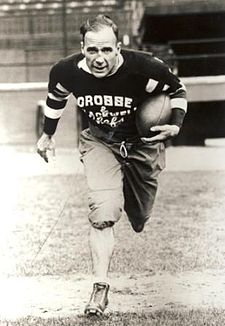
Interesting note, he is also one of two athletes to have his name both on the Grey Cup and the Stanley Cup.
Another interesting note, following his athletic career, Conacher became involved in politics as a Liberal MP for Bracondale and later Trinity.
Another interesting note: Conacher died of a heart attack while playing softball in 1954. He was born in 1902. Think about that now. This athlete, this great athlete died young. Of a heart attack. While playing softball. Tell me you don't see the irony there?
And yet, in some ways it is perfectly logical. The brightest flame burns half as long, as they say. Maybe he pushed himself too hard, tried to do too much, and his body just plain crapped out on him. So I guess, that raises the question: is it worth it to do as much as you possibly can in your youth, and risk burning out by middle age; or is it better to take it slow, pace yourself, achieve big things and little things in good time, and die at a ripe old age.
I don't really have the answer here. Both have their own appeal. Its too late for me to do the former, anyway, so I suppose I shall pursue the latter. Slow down, take life at life's pace. No pushing, no rushing.
After all, we all wind up at the same place, eventually.
Tuesday, 19 March 2013
Freedom
So, I've had a lot of reasons to be pretty introspective and self-scrutinizing lately. I've come up with a few things in me that I'd like to change. Character traits I'd like to free myself of. I know, I know, you're supposed to embrace your flaws, not override them--so maybe change isn't even possible. But these are unhealthy things about me that I would like to root out.
Sorry in advance for the personal post, guys. Its a diary moment. I could write about this in my actual paper journal, but I'm hoping there will be some interesting food for thought in here. Or maybe I'm just too tired to use a pen. Anyway . . .
Things I'd like to be free of:
Guilt- Guilt is a big thing for me. Its haunted me for forever. People get irritated with me because I'm constantly saying "I'm sorry" and "Are you mad at me?", even (especially) when I've done nothing wrong. The reason I constantly feel guilty partly goes back to my childhood, when I felt it was my personal responsibility to keep my family on an even keel. I did a pretty good job, but whenever things began to fall apart, I would take that as a personal failure on my part. Hence, guilt. The other reason I feel guilt is because somehow this sense of responsibility for everyone else's wellbeing has spread to the entire world for me. I've folded, caved. I have been unable to help everyone in the world. There are problems I have to outright ignore. Once again, this inability to help everyone on the planet feels like a personal failing, and I feel constant, intense guilt.
Sadness - Let me preface this by saying I don't want to be entirely free of sadness. Sadness can be healthy. Tears are a good way to release intense emotion. What I mean when I say I want to be free of sadness (and this is something almost no one will understand) is I want to be free of the lingering sense of sadness that I carry with me in the pit of my stomach. Like, all the time. From other bipolars I've talked to (there's that topic again . . .I can see you rolling your eyes), there is a core of intense emotion in them that can't be shaken. Often, this is an intense sadness that just sits there in your gut. Its not sadness for any particular reason. It feels like all of the sadness in the world has been soaked into you like a sponge. My theory is that manic phases are an effort to drown out the sadness, while depressive phases are succumbing to it. When my meds are on track, that feeling goes away, and life feels much less difficult because I'm not dealing with all the sadness in the world, so maybe there is something to my theory that intense sadness is just part of the whole bipolar shtick.
Fat - I know what I should say here is "I want to be free of my poor body image", but most of the time I don't really have one. I look like a goof. Sometimes I look like a slob. I've never had a model's body, and I never will. My personality makes me endearing, I think, so I really don't have so many poor body image issues as I did a few years back. Before I realized how cool I am (ego kick). But yes, I do want to get rid of my massive coating of fluff (under which there is a good deal of muscle, I think). Sometimes I feel trapped in my own body. Like I'm drowning in unnecessary pounds of flesh. It feels yucky. I don't like it. This is an easy fix, and yet a hard one. So difficult to get up the energy to pursue a fitness regimen when its constantly snowing and cold and your body is telling you to hibernate.
Compulsive Behavior - Once again, this may be associated with bipolarity, but that really isn't an excuse. I tend to get very dog-with-bone about certain things. I'll get an idea in my head, a notion, a perceived problem, and I will.not.rest. until whatever it is has been resolved. This is not only exhausting, but it makes me pretty much harass anyone who might be involved until they cave and talk to me about it.
The Need for Positive Affirmation - Positive feedback from people is a good thing. . .a wonderful thing, when freely given. My problem is, I often dig for it. Try to get people to give it to me. Part of this is an anxiety issue, part of it ties back to my guilt. I want people to reaffirm for me that I am indeed a good person, despite my failings. This is probably the trait that ticks me off the most about myself. I should be stronger. I should be able to give myself that affirmation. In general, I should feel more secure. Its annoying to me, and its annoying to other people. I don't know why I do it, and I don't know how to stop.
The truth is, I don't know how to be free any of these things, really (except being fat and to an extent being compulsive). I can't bend my head around concepts of just picking myself up and not feeling sad, accepting myself as I am so I don't need affirmation, realizing that there is no reason to feel guilt. I try to understand these things, but I can't. Its like my brain shuts off and goes a little slackjawed when I try to work through it in my mind.
So, that's where I am, and more about me than any of you wanted to know. If anyone has any suggestions for me on how to work on some of this crap, please send them my way. I really don't want to pay for a therapist :p
Sorry in advance for the personal post, guys. Its a diary moment. I could write about this in my actual paper journal, but I'm hoping there will be some interesting food for thought in here. Or maybe I'm just too tired to use a pen. Anyway . . .
Things I'd like to be free of:
Guilt- Guilt is a big thing for me. Its haunted me for forever. People get irritated with me because I'm constantly saying "I'm sorry" and "Are you mad at me?", even (especially) when I've done nothing wrong. The reason I constantly feel guilty partly goes back to my childhood, when I felt it was my personal responsibility to keep my family on an even keel. I did a pretty good job, but whenever things began to fall apart, I would take that as a personal failure on my part. Hence, guilt. The other reason I feel guilt is because somehow this sense of responsibility for everyone else's wellbeing has spread to the entire world for me. I've folded, caved. I have been unable to help everyone in the world. There are problems I have to outright ignore. Once again, this inability to help everyone on the planet feels like a personal failing, and I feel constant, intense guilt.
Sadness - Let me preface this by saying I don't want to be entirely free of sadness. Sadness can be healthy. Tears are a good way to release intense emotion. What I mean when I say I want to be free of sadness (and this is something almost no one will understand) is I want to be free of the lingering sense of sadness that I carry with me in the pit of my stomach. Like, all the time. From other bipolars I've talked to (there's that topic again . . .I can see you rolling your eyes), there is a core of intense emotion in them that can't be shaken. Often, this is an intense sadness that just sits there in your gut. Its not sadness for any particular reason. It feels like all of the sadness in the world has been soaked into you like a sponge. My theory is that manic phases are an effort to drown out the sadness, while depressive phases are succumbing to it. When my meds are on track, that feeling goes away, and life feels much less difficult because I'm not dealing with all the sadness in the world, so maybe there is something to my theory that intense sadness is just part of the whole bipolar shtick.
Fat - I know what I should say here is "I want to be free of my poor body image", but most of the time I don't really have one. I look like a goof. Sometimes I look like a slob. I've never had a model's body, and I never will. My personality makes me endearing, I think, so I really don't have so many poor body image issues as I did a few years back. Before I realized how cool I am (ego kick). But yes, I do want to get rid of my massive coating of fluff (under which there is a good deal of muscle, I think). Sometimes I feel trapped in my own body. Like I'm drowning in unnecessary pounds of flesh. It feels yucky. I don't like it. This is an easy fix, and yet a hard one. So difficult to get up the energy to pursue a fitness regimen when its constantly snowing and cold and your body is telling you to hibernate.
Compulsive Behavior - Once again, this may be associated with bipolarity, but that really isn't an excuse. I tend to get very dog-with-bone about certain things. I'll get an idea in my head, a notion, a perceived problem, and I will.not.rest. until whatever it is has been resolved. This is not only exhausting, but it makes me pretty much harass anyone who might be involved until they cave and talk to me about it.
The Need for Positive Affirmation - Positive feedback from people is a good thing. . .a wonderful thing, when freely given. My problem is, I often dig for it. Try to get people to give it to me. Part of this is an anxiety issue, part of it ties back to my guilt. I want people to reaffirm for me that I am indeed a good person, despite my failings. This is probably the trait that ticks me off the most about myself. I should be stronger. I should be able to give myself that affirmation. In general, I should feel more secure. Its annoying to me, and its annoying to other people. I don't know why I do it, and I don't know how to stop.
The truth is, I don't know how to be free any of these things, really (except being fat and to an extent being compulsive). I can't bend my head around concepts of just picking myself up and not feeling sad, accepting myself as I am so I don't need affirmation, realizing that there is no reason to feel guilt. I try to understand these things, but I can't. Its like my brain shuts off and goes a little slackjawed when I try to work through it in my mind.
So, that's where I am, and more about me than any of you wanted to know. If anyone has any suggestions for me on how to work on some of this crap, please send them my way. I really don't want to pay for a therapist :p
Monday, 18 February 2013
Montreal Museum of Fine Arts
Okay, so this isn't really a post about the Montreal Museum of Fine Arts (or le Musee des Beaux Arts), but I am going to talk a bit about it, and then I am going to talk more in depth about one particular work it holds.
I have visited the Museum of Fine Arts twice since moving to Montreal. It is a massive three buildings, containing a massive collection of art, ranging from ancient artifacts, medieval works, through the renaissance, with a particular focus on Quebec art, and Modern Art (or Modern Quebec Art). It is at least a two hour trip if you want to look at it all (not including the special exhibition of the moment, which is usually pretty interesting. Still regret missing Renoir) and by the time you hit the gigantic display of chairs (yes, chairs) you're pretty exhausted.
Somewhere between the Renaissance and the collection of chairs, you hit a hallway of very abstract, very modern art (postmodern? my terminology is rusty). Off of these hallways are large galleries, containing more fascinating works of the weird and wonderful. I should say that I love modern/postmodern art (these are blurry blurry lines for me. Please don't be offended, art critics). I love interpreting it. I am drawn to it, in an effort to understand. And honestly, wildly paint splattered, multimedia, hectic presentations inspire more emotion in me than a well done rendition of a bowl of fruit. Just saying.
But then you come to this:
And your first reaction is one of absolute revulsion. I should say that it looks a lot more realistic an a lot more disturbing in person. The monkey are actually hairy, and in a yellow lighting that makes the wax look more like real skin.
Anyway, you stop, and feel absolute revulsion. This is cannibalism. This is murder. This is a bunch of monkey genitals and fat rolls all up in your grills. What the hell is this?
I'll admit, the first time I visited the museum, I quickly hurried off, not wanting to look at it any longer than I had to. The second time, however, was a different deal. I wanted to think about it. What the hell is this? And this time, I wanted an answer.
The interpretation of this piece is, I think, rather straightforward. These monkeys are society in a nutshell, the hate between classes. Poor social conditions, hunger, homelessness, drives some to commit acts of theft or murder against those that have more. The lean, through no fault of their own, can get mean, and begin to resent the affluent. This can be seen on a global scale as well. Why are first world countries so resented, America in particular? Because we are the world's morbidly obese apes. We get ALL the bananas.
And this moves in cycles, historically has moved in cycles--hence, I believe, the title of the work. Look back at the revolutions overthrowing monarchies over the centuries. Those without--the lean and hungry famine-struck apes--rebel against those with--the ruling class--destroying them absolutely (more or less). In the process, those leading the revolution, those demanding the most meat off of the bones of the bloated corpse of the overthrown become bloated themselves. Filled with power. And the cycle begins again.
I think that is what is so disturbing about these apes. They are us.
Or maybe its just the dangling balls.
I have visited the Museum of Fine Arts twice since moving to Montreal. It is a massive three buildings, containing a massive collection of art, ranging from ancient artifacts, medieval works, through the renaissance, with a particular focus on Quebec art, and Modern Art (or Modern Quebec Art). It is at least a two hour trip if you want to look at it all (not including the special exhibition of the moment, which is usually pretty interesting. Still regret missing Renoir) and by the time you hit the gigantic display of chairs (yes, chairs) you're pretty exhausted.
Somewhere between the Renaissance and the collection of chairs, you hit a hallway of very abstract, very modern art (postmodern? my terminology is rusty). Off of these hallways are large galleries, containing more fascinating works of the weird and wonderful. I should say that I love modern/postmodern art (these are blurry blurry lines for me. Please don't be offended, art critics). I love interpreting it. I am drawn to it, in an effort to understand. And honestly, wildly paint splattered, multimedia, hectic presentations inspire more emotion in me than a well done rendition of a bowl of fruit. Just saying.
But then you come to this:
 |
| Old Enemy, New Victim by Tony Matelli |
Anyway, you stop, and feel absolute revulsion. This is cannibalism. This is murder. This is a bunch of monkey genitals and fat rolls all up in your grills. What the hell is this?
I'll admit, the first time I visited the museum, I quickly hurried off, not wanting to look at it any longer than I had to. The second time, however, was a different deal. I wanted to think about it. What the hell is this? And this time, I wanted an answer.
The interpretation of this piece is, I think, rather straightforward. These monkeys are society in a nutshell, the hate between classes. Poor social conditions, hunger, homelessness, drives some to commit acts of theft or murder against those that have more. The lean, through no fault of their own, can get mean, and begin to resent the affluent. This can be seen on a global scale as well. Why are first world countries so resented, America in particular? Because we are the world's morbidly obese apes. We get ALL the bananas.
And this moves in cycles, historically has moved in cycles--hence, I believe, the title of the work. Look back at the revolutions overthrowing monarchies over the centuries. Those without--the lean and hungry famine-struck apes--rebel against those with--the ruling class--destroying them absolutely (more or less). In the process, those leading the revolution, those demanding the most meat off of the bones of the bloated corpse of the overthrown become bloated themselves. Filled with power. And the cycle begins again.
I think that is what is so disturbing about these apes. They are us.
Or maybe its just the dangling balls.
Subscribe to:
Posts (Atom)