Monday, 12 May 2014

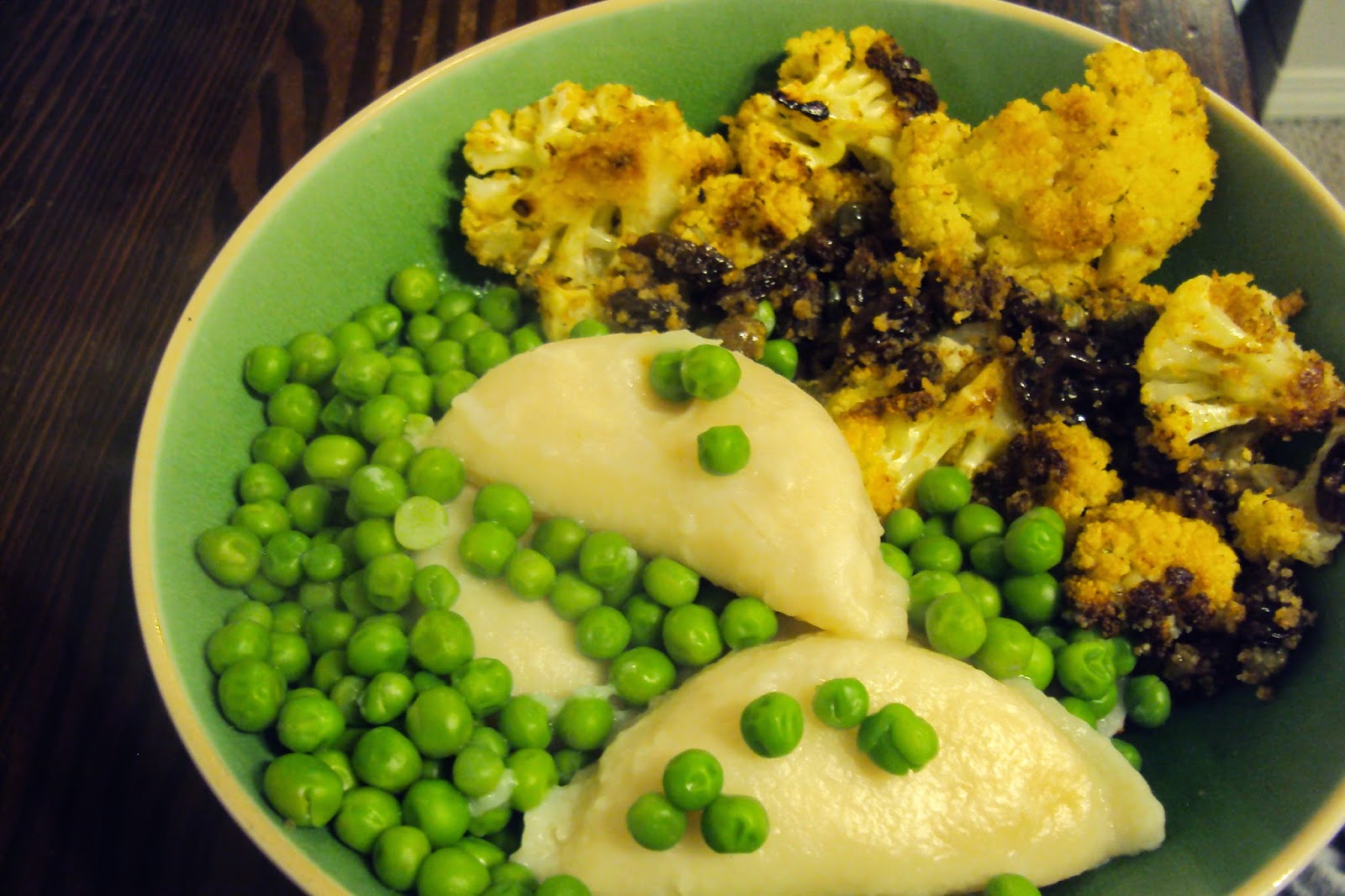
Crispy Cauliflower with Capers, Raisins, and Breadcrumbs

Okay, so I don't even like cauliflower, but this turned out *amazing*. It is probably the longest I will ever spend preparing cauliflower in my life, because there were so many goofy little components, but well worth it.


2 heads  cauliflower, cut into florets
6 tbsp olive oil
3 cloves garlic, thinly sliced
2 tbsp salt-packed capers, soaked, rinsed and patted dry
¾ cup fresh, coarse breadcrumbs
½ cup low-salt chicken stock
cup sultanas1 tbsp white wine vinegar or
Champagne vinegar
Sea salt and freshly ground
black pepper
30g Italian parsley, chopped
[Preheat oven to 220°C]
Toss cauliflower florets with 3 tbsp of olive oil in a large bowl. Spread the cauliflower out in a single layer on two shallow baking trays lined with baking paper. Roast, tossing occasionally, until the cauliflower is golden and crispy, about 20–25 minutes.
Heat 3 tbsp of olive oil in a small saucepan over medium-low heat. Add garlic and cook, stirring occasionally, until just golden, about 2–3 minutes. Watch carefully that the garlic does not burn. Turn the heat up slightly, add the rinsed capers and cook until they start to pop, about 3 minutes longer. Add breadcrumbs and toss to coat. Cook, stirring often, until breadcrumbs are golden, about 2–3 minutes. Transfer the breadcrumb mixture to a plate and set aside.
In the same saucepan, heat the chicken stock to a boil. Add the sultanas and the white wine vinegar and cook until almost all the liquid is absorbed, about 5 minutes. Remove from heat and set aside.
Transfer warm cauliflower to a serving bowl. Scatter the sultana mixture over, then toss to distribute evenly. Season to taste with salt and white pepper. Sprinkle the cauliflower with the garlic capery breadcrumbs and the chopped Italian parsley.

Friday, 9 May 2014

Chickpeas with Leeks and Lemon


I stole this simple dish from Oprah. That's right, right out of her hands. Because I'm awful like that. My advice is to go easy on the flavoring--I found it didn't need much, and it came out superb. I used the rest of the lemon to make a honey lemon hot drink for my sick self. 

Ingredients

  • 1/4 cup extra-virgin olive oil
  • 1 large garlic clove, peeled and bruised but whole
  • 1 6-inch branch fresh rosemary, broken in two
  • 4 leeks, cleaned, trimmed and with the white and light green parts sliced in 1/4-inch rounds
  • Kosher salt, to taste
  • 2 cups cooked chickpeas (garbanzo beans)
  • 1/2 lemon

Directions


In a large skillet, heat the olive oil, garlic and rosemary over medium heat. Once the garlic turns fragrant and the rosemary begins to sizzle, remove the rosemary, setting it aside for later. 

Add the leeks to the pan, along with a good pinch of salt. Cook, stirring often, until the leeks are soft and sweet but still brightly green, around 5-8 minutes. Tip in the chickpeas, and continue to cook, turning the beans in the oil, for 5 minutes more, at which point the chickpeas should have darkened slightly in color. 

Using a microplane or zester, add a few scrapes of lemon zest to the pan, along with a squeeze of lemon juice. Stir gently to combine. Check for seasoning, adding more juice, zest or salt as needed. Return the reserved rosemary sprigs to the pan, and enjoy warm or at room temperature. 

A complex relationship with language

. . .or a language complex. . .

Reading kills meaning
as writing slays word.s
Language a slag heap
of bloodied nouns,
broken adjectives,
twitching verbs.

There is a certain type of former English major who suffers a form of literary ptsd. I am one of them. Pursuing my degree ruined me for pleasure reading (simple pleasure reading, anyway--now I always always must analyze what  is being read on a more complex level). Likewise, my ability to string a sentence together in a way that seems clever without sounding trite has been torn from me, and I bumblefuck my meaning across, bleating like a tongueless antelope. (See?)

It's like there are two extremes of interaction with language, and only a certain personality type is able to walk the knife's edge between the two and experience true literary contentment. On the one side, we have an extreme where things like reading and writing seem so dull, onerous, and unnecessary, that individuals would rather lick sandpaper than read a line of Shakespeare. Let us call this extreme that of literary ignorance. People in this category much prefer swifter forms of communication like texting. At the other extreme, we have individuals who find themselves so trapped in a neverending Hell of literary analysis they would rather stab out their own eyes with forks than read another line of Shakespeare. Let us call this extreme that of literary over-saturation. This would be the category I fall into, I think.

Could the ever narrowing gap of literary contentment between these two extremes be part of why language itself seems to be going the way of the dodo? Are we all so impatient with language, or so worn out on it, that we would rather grunt and stab at small screens with our thumbs than communicate openly with our tongues?

I don't have an answer. Ask me again when I'm not running a fever.

Monday, 14 April 2014

Turkish Salmon


Tangy and delicious! 

Preparation time: 15 minutes                                    Cooking time: 30 minutes
4 salmon fillets
16-18 cherry tomatoes, halved
30ml/2 tablespoons olives, pitted and halved
3 small fillets of anchovies in olive oil (from the tin); drained
30ml/2 tablespoons olive oil
Ground black pepper to taste
 Wedges of lemon to serve
For broccoli & the dressing:
Broccoli
Juice of 1/2 lemon
1-2 cloves garlic, crushed and finely chopped
30ml/ 2 tbsp. extra virgin olive oil
Preheat the oven to 180C/350F/Gas 4
Grease the baking tray with the olive oil and place the salmon fillets on it. Spread the cherry tomatoes, olives and the anchovy fillets over and around the salmon fillets. Season with ground black pepper. Place the tray in the preheated oven for about 20-25 minutes (please refer to cooking instructions at the packaging as cooking time may vary with the size  or type of the fish), until the fish is cooked and the tomatoes starting to turn crisp at the edges.
While the salmon is in the oven, prepare the broccoli. Steam the broccoli over a pan of boiling water for a few minutes. Cool the broccoli in iced water and set aside in a serving bowl. Combine the olive oil, chopped garlic and the lemon juice in a bowl and drizzle this sauce over the broccoli, mix well.

Sunday, 13 April 2014

The Big Parade


So, I decided to treat myself to a movie on Friday, and this is the title that came up. The Big Parade  is a silent film from 1925 set during the First World War. It features a young dandy named Jim who throws in and joins the army (much to his mother's chagrin) where he befriends two working class gentlemen: the perpetual tobacco gob chewing Slim, and the tough but hard-luck Bull. After being deployed to France, his unit spends several (weeks? months?) at a small French village where, despite being engaged to someone back home, Jim falls hard for the feisty (and I think absolutely gorgeous) Melisande, played by Renee Adoree:

Isn't she adorkable? I was so sad to hear she died of TB only a couple of years after the filming of this movie. 

Their courtship is delightfully slapstick, involving a barrel, bare buttocks, chewing gum, a swift right hook,and many many giggles. You really can't help but smile watching the pair struggle to convey their mutual attraction across the language barrier (something which seems to work especially well in silent film as medium). 

Another thing about silent film, which I love, is the fact that because so much work must go into making the visuals communicate the story, you could pretty much take a screencap of any point in the film and frame it and put it up on your wall. 

As an experiment, lets do just that: 


1) Jim hits on Melisande on the riverbank. Sure, I'd make this into a poster! Their smiles are so lovely. 

2) The new recruits are greeted by "Flying Fitz" in this scene. Maybe not posterworthy, but definitely could have a small copy in a frame. 


3) . . .And this happened . . .

Well, maybe not. 

Anyway, what I really admired about this movie was the abrupt turnaround it made in the second half. This was a turnaround which was wholly uncharacteristic for the time. The movie went from patriotic beginnings, to the cheerful silly warm days in the village in France, to portraying (probably at least somewhat accurately given how close it was in memory in 1925, and based on my own understanding of how the war was tactically--or not tactically-- fought) the absolute Hell WWI put those boys through. And by "those boys" I don't just mean the Americans--the film turns out to be surprisingly sympathetic to all sides fighting (something we could stand to see a little more of in our war films today, I might add). 

The phrase "The Big Parade" alters meaning entirely from the beginning of the movie to the end. At the start, there is a jubilant sort of excitement as the "Parade" is a patriotic march to the front and to glory. By the end, we are shown a long trail of medical vehicles hauling the wounded back from the front, and the caption comes up "Another Big Parade." 

The field hospital where Jim winds up after taking an arrow to the knee is also portrayed with a sort of chilling accuracy unlike anything we see in renditions of the war today. Flies are everywhere, crawling over our heroes face,  and in a bed near Jim, a man is tied down, screaming in the throes of PTSD. There are no pretty, spankable nurses to be seen, and the "hospital" is not really anything like a hospital-- just rows of cots in a gutted out church. Jim himself appears to have been altered by his experiences at the front. Something sour, blank, and haunted has come over his expression and if you were to compare him to the dandy from the start of the movie, you would hardly recognize the same man. 

This was a time when few but the writers wanted to talk about the human costs of the war (and even the writers did so in a less than direct manner), but The Big Parade takes it on with directness and humanity, tempered with comedy and a bit of drama. This could easily have been a fluffy romantic film. It could easily have been *enjoyable* as a fluffy romantic film. But it went one step further, and that's what made it a classic worthy of preservation in the National Film Registry. 

Thursday, 6 March 2014

Sonnet CXXIV

Here is a sonnet by Petrarch, as translated by Macgregor:
HE RECALLS HER AS HE SAW HER WHEN IN TEARS

That ever-painful, ever-honour'd day
So left her living image on my heart
Beyond or lover's wit or poet's art,
That oft to it will doting memory stray.
A gentle pity softening her bright mien,
Her sorrow there so sweet and sad was heard,
Doubt in the gazer's bosom almost stirr'd
Goddess or mortal, which made heaven serene.
Fine gold her hair, her face as sunlit snow,
Her brows and lashes jet, twin stars her eyne,
Whence the young archer oft took fatal aim;
Each loving lip—whence, utterance sweet and low
Her pent grief found—a rose which rare pearls line,
Her tears of crystal and her sighs of flame.


The way in which the girl is described in this reminded me of something . . .